
How Do Hotel PBX Phones Work in Guest Rooms?
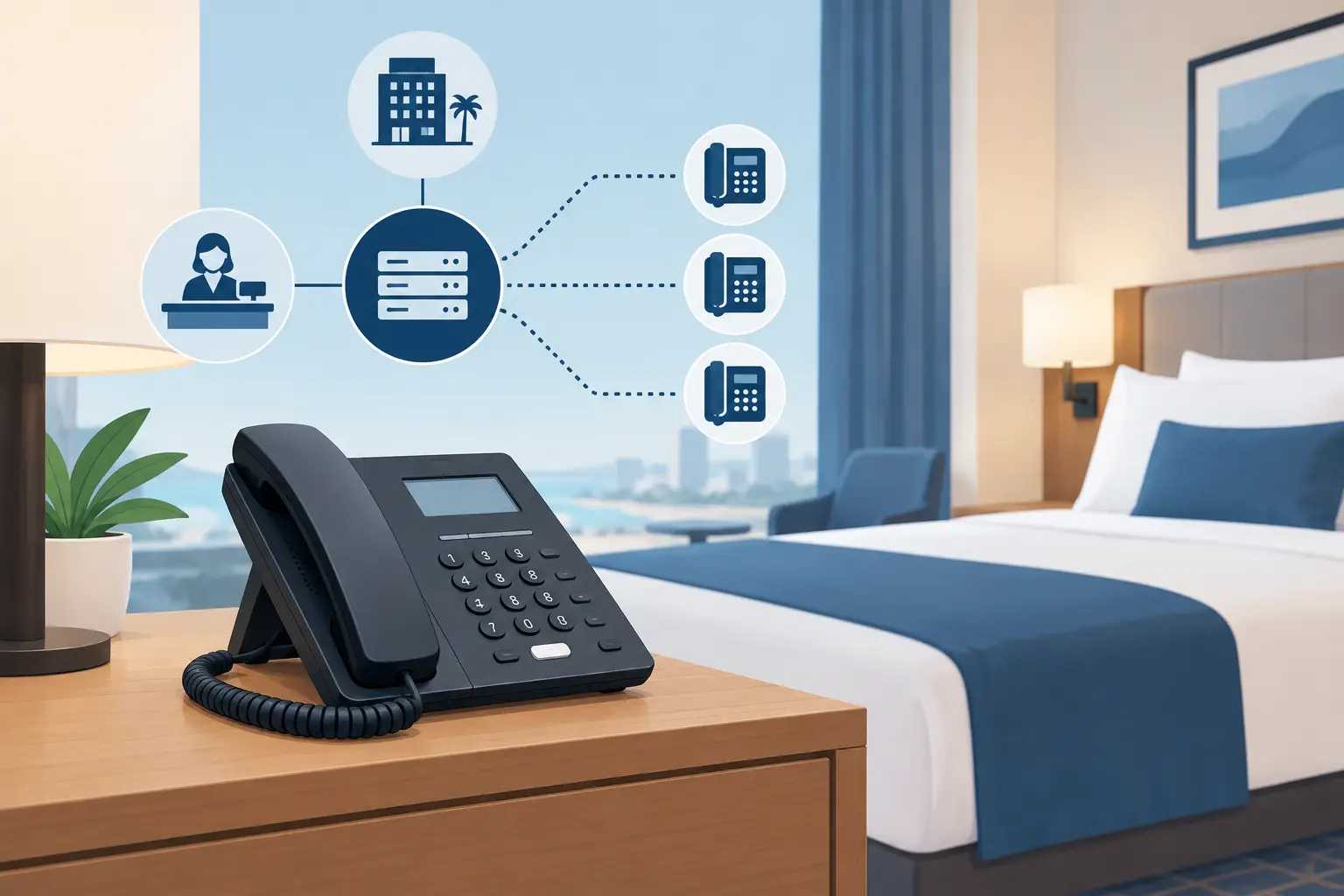
A guest lifts the handset at 2am to ask for an extra pillow. In a well-planned hotel, they should reach the right team with one button press, without needing a mobile signal, an app or a room number. That simple interaction is the visible end of a much larger system. When hotel owners ask, “how do hotel PBX phones work?”, the answer starts with a private telephone network that connects guest rooms, reception, back-office teams and outside lines.
For a hotel, the PBX is not simply a way to make calls. It supports service, operational response and the character of the guest room itself. The right handset can sit naturally within a heritage interior while meeting the requirements of a modern analogue or SIP/IP installation. Retro does not mean dated, provided the telephone and the system behind it have been specified together.
What a hotel PBX actually does
PBX stands for Private Branch Exchange. It is the hotel’s internal telephone system: traditionally an on-site control unit, and increasingly a software-based or hosted platform. It assigns an extension to each room, department and staff location, then decides where calls should go.
A guest-room telephone might be extension 214. Dialling reception could send the call to a front-desk console, a hunt group of several staff members, or an overflow point if the main desk is busy. Dialling another room can place an internal call without using an external telephone line. Calls to local, national or international numbers are routed through the hotel’s selected carrier, subject to the dialling permissions set by management.
The PBX also lets the hotel create a sensible dial plan. A single key can call reception, housekeeping or concierge. Departments can be reached by short codes, while staff mobile phones, maintenance offices and night teams can be included in call-routing rules. The exact configuration depends on the size of the property and how it operates after hours.
How hotel PBX phones work from room to reception
The telephone in the room is the endpoint. When the guest presses a service key or dials a number, the handset sends a signal down its connection to the PBX. The PBX recognises the extension, checks the number or programmed key selected, and routes the call.
With an analogue system, the room phone connects by conventional copper cabling, often through an RJ11 socket. The PBX provides the line and signalling needed for the call. This remains common in established hotels, particularly where existing infrastructure is reliable and a refurbishment does not justify replacing every cable run.
With a SIP/IP system, the telephone connects to the hotel data network, usually through Ethernet cabling. SIP, or Session Initiation Protocol, is the standard used to set up and manage voice calls over an IP network. The PBX may be installed on site, delivered through a cloud service, or managed by the hotel group’s central technology team.
To the guest, both can feel much the same: lift the handset, hear a dial tone and press reception. Behind the scenes, however, the infrastructure, power arrangements and commissioning process are different. A SIP handset must be compatible with the chosen platform and correctly provisioned on the network. An analogue handset must match the line characteristics and features of the existing PBX.
Direct-dial keys are programmed for service
The familiar reception button is not just a decorative label. It is usually programmed as a speed dial or feature key. Depending on the PBX, it may call a fixed extension, a department group or a routing rule that changes by time of day.
For example, a daytime reception key may ring the front desk first, then the duty manager if unanswered. Overnight, the same key may route directly to a night porter or outsourced call-handling service. Hotels can also programme keys for housekeeping, room service, emergency assistance or a central reservations line, where appropriate for the property.
Clear labelling matters. A guest should not need to decipher technical abbreviations while tired, travelling or unfamiliar with the hotel. This is one reason bespoke faceplates, branded key labels and considered handset design are valuable in hospitality projects.
The PBX, the PMS and call charging
Many hotels connect the PBX to their property management system, known as the PMS. The PMS holds room status, guest details and billing information. When a guest checks in, the integration can activate the room extension for permitted outgoing calls. When they check out, the system can restrict or reset that extension for the next guest.
Where chargeable external calls are offered, the PBX can record call data such as the originating room, destination, duration and carrier charge. That information can then be passed to the PMS for review or posting to the guest account. Some hotels no longer charge for most calls and configure their systems accordingly; others still need controlled international calling or business-service options.
This integration is useful, but it is not automatic. Compatibility between the PBX, PMS and any middleware should be confirmed before equipment is ordered. It also needs testing during commissioning, particularly for check-in, check-out, wake-up calls and call accounting rules.
Analogue or SIP/IP: choosing the right hotel phone connection
The decision is usually led by the building and existing system, not simply by appearance. Analogue telephones are straightforward, dependable and often a practical choice for a hotel retaining a legacy PBX. They can be particularly suited to phased refurbishments where replacing network infrastructure would be disruptive or disproportionate.
SIP/IP telephones offer a different set of benefits. They can support central management, flexible call routing and deployment across multiple sites, and they commonly use Power over Ethernet. PoE can reduce the need for a separate power adaptor at the bedside, although it means the network switches must provide sufficient power and backup arrangements.
Neither route is universally better. A small independent hotel with sound analogue wiring may gain more from a high-quality analogue room phone than from an unnecessary infrastructure change. A new-build or major renovation may be better served by SIP/IP from the outset, especially if the wider building network, staff communications and group standards are already IP-led.
For either option, ask the supplier to confirm compatibility rather than assuming that every telephone will work with every PBX. Connector type, line voltage, message waiting indication, speed-dial programming, network provisioning and PoE requirements can all affect the final choice.
Hotel handsets need to work hard and look considered
A guest-room telephone has a more visible role than many back-office devices. It sits beside the bed or on a desk, often within an interior carefully designed to create a particular sense of place. A generic black handset may technically work, yet undermine a boutique scheme or heritage-led room concept.
That does not mean prioritising style over operation. Hospitality phones should be easy to clean, stable on their base, clear to use and appropriate for the chosen network. They should also suit the practical layout of the room. A corded telephone remains useful in many properties because it is familiar, dependable and readily available in a power interruption where the underlying analogue system has resilience. SIP installations need their own power-continuity planning.
GPO Retro supplies hospitality telephones in vintage-inspired designs for analogue and SIP/IP deployments, with custom colours and logo branding available for projects that need the telephone to belong to the room rather than merely occupy it.
Points to settle before specifying a hotel PBX phone
A successful project begins with a short technical brief shared between the hotel, its IT or telecoms partner, interior team and telephone supplier. Establish whether the existing service is analogue, digital proprietary or SIP/IP. Proprietary digital systems can require manufacturer-specific handsets and should never be treated as standard analogue lines.
Then define the guest experience. Decide which services need dedicated keys, whether names or icons will be used, and whether different room types need different layouts. Consider accessibility too: readable legends, tactile controls, adjustable volume and sensible positioning can make a material difference.
Finally, plan for operations after installation. Reception and engineering teams should know how to test each extension, change labels where permitted, report a fault and recognise whether an issue lies with the handset, cabling, PBX or network. Keep a small quantity of approved spare phones for quick room turnaround, especially across larger estates.
Commissioning checks that prevent avoidable faults
Before rooms are released, test more than a dial tone. Confirm that each extension reaches reception, dedicated service keys follow the right day and night routing, and internal room-to-room calls behave as intended. Check outgoing-call permissions, message waiting indication where used, and PMS check-in and check-out behaviour.
For SIP deployments, also verify network addressing, voice quality, switch power capacity and recovery after a network or power event. Emergency calling requirements vary by territory and property type, so these routes should be agreed with the PBX provider and tested against local obligations rather than left to assumption.
A hotel telephone earns its place when it removes friction at the exact moment a guest needs help. Specify the connection correctly, programme the service journey carefully and choose a handset that reflects the property. The result is a small but lasting detail that makes the room feel properly considered.