
How to Configure Hotel Emergency Speed Dials
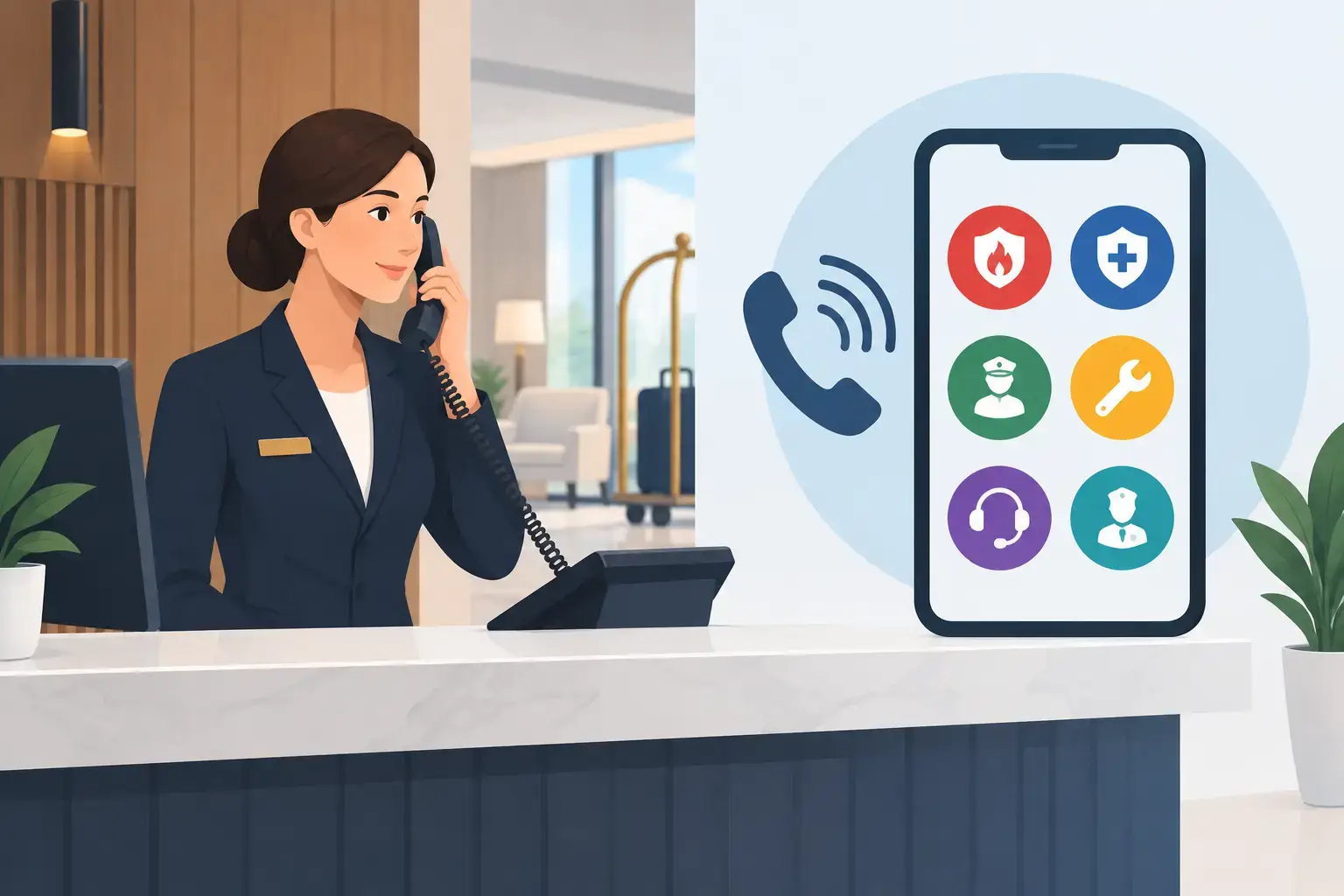
A guest in distress should not have to understand your phone system before they can ask for help. When you configure hotel emergency speed dials, the aim is simple: one clearly marked action should connect the caller to the right person or service, from the right room, without delay.
For hotel owners, project teams and telecoms specialists, however, the programming itself is only one part of the job. The dial plan, PBX rules, local emergency requirements, handset layout and regular testing all affect whether that button works as intended. A beautifully specified guest-room telephone still needs a considered emergency calling plan behind it.
Start with the call path, not the handset
Before assigning any speed dial, decide exactly where an emergency call must go. In some properties, a guest-room emergency key should reach reception or a 24-hour duty team first. In others, it may need to call an external emergency service directly, or follow a defined escalation route that alerts both the local team and external responders.
There is no universal setting. A city hotel with a permanently staffed reception has different operational needs from a resort, serviced accommodation scheme or small property with overnight security provided remotely. Local regulations, the capabilities of the telephone platform and the property's own emergency procedures must all be considered.
This discussion should include the general manager, operations lead, security team and PBX or SIP/IP installer. Agree the destination number, whether an outside-line prefix is required, and what caller information the receiving party will see. If the call reaches emergency services, the room or extension number and site address may be critical. Do not assume the PBX will supply this information automatically.
In the UK, both 999 and 112 connect to the emergency services. Whatever the emergency key does, a guest who dials either number directly from the room phone should still get through, so check that the PBX does not block them or require an outside-line prefix first.
Choose the right emergency dial arrangement
A labelled one-touch key is usually the clearest option for a guest room. It is visible, immediate and easier to use under pressure than asking a guest to remember a short code. On many hospitality telephones, programmable memory keys can be labelled for Reception, Emergency or a site-specific contact, depending on the agreed call path.
A short dial code can still have a place, particularly for staff areas or where the telephone has limited programmable keys. The trade-off is that codes rely on the user knowing what to dial. For guest rooms, a dedicated key is generally the more intuitive choice.
Avoid creating ambiguity. A key marked “Emergency” should not lead to voicemail, an unattended desk or a general switchboard queue. Similarly, a button marked “Reception” should not be treated as an emergency provision unless the hotel is confident that reception is continuously monitored and able to respond.
Separate guest and staff requirements
Guest-room phones should be simple. A guest may need immediate access to reception, security or a nominated help point, with clear wording that matches the hotel's procedures. Staff phones can be configured differently, with keys for security, maintenance, duty manager, housekeeping or local emergency services where appropriate.
This is particularly useful in larger properties. A night porter may need a direct security call, while a guest needs a single point of contact that can coordinate the response. Programming every handset identically can look tidy on paper but may not suit real operations.
How to configure hotel emergency speed dials on your system
The method depends on whether the property uses analogue extensions or a SIP/IP deployment. In either case, document every programmed destination before installation begins. That makes commissioning quicker and gives the hotel a reliable record for future changes.
Analogue hotel telephones
With analogue guest-room telephones, speed dials may be stored in the telephone itself, configured through a memory-programming sequence, or managed through the PBX depending on the equipment in use. The phone may store the number assigned to a memory key, while the PBX determines whether it needs a digit prefix to access an outside line.
This distinction matters. A number that works when dialled from reception may fail from a guest room if the extension class of service blocks external calls, requires a prefix or restricts emergency routing. Test from the installed guest-room extension, not simply from an engineer's test point.
Where an analogue phone includes a programmable emergency button, programme the full dial string required by that extension. This may include an outside-line access digit, pauses where supported, or a short internal number. Use pauses carefully: too short and the system may not be ready to accept the remaining digits; too long and the guest experiences an unnecessary delay.
SIP/IP hotel telephones
For SIP/IP systems, emergency keys may be configured through the telephone's web interface, central provisioning platform or the hosted PBX portal. Central provisioning is often preferable for multi-room projects because it keeps key assignments consistent and allows changes to be deployed across an estate without visiting every room.
All GPO SIP phones support auto-provisioning and firmware upgrades over the web, and come with an RJ45 patch cable for installation. On models such as the GPO 746 Push Button SIP or GPO Carrington SIP, that means key assignments can be set once and pushed to every room.
Assign the key to the correct speed-dial, BLF or direct-dial function supported by the handset and platform. A direct-dial setting may suit a fixed internal destination, while a platform-managed emergency route can provide more control over caller location, call recording policies and failover behaviour.
Check what happens if the primary destination is unavailable. A well-designed SIP/IP route might send an unanswered call to the duty manager after a defined interval, then to a secondary number. Yet escalation must not introduce confusion or mask a failed route. The first destination should be monitored, and the escalation logic should reflect the hotel's actual staffing model.
Label the key for a guest who has never seen it before
Programming is only useful when the guest can identify the right control instantly. Use high-contrast, legible labels and avoid internal language that guests will not understand. “Emergency Assistance” may be clearer than a department name, while “Reception” remains appropriate for normal service requests.
The wording should also reflect the call destination honestly. If the key calls the hotel's response team rather than public emergency services, do not label it in a way that suggests a direct connection to police, ambulance or fire services. Clear language protects guests and helps staff manage expectations during a serious incident.
For design-led properties, this need not compromise the room scheme. Hospitality telephones can be specified in colours that complement the interior, with bespoke branding and professionally prepared key legends. The classic silhouette may bring character to a bedside table, but the labelling must remain functional in low light and under stress.
Test the whole journey, not just the dial tone
An emergency speed dial should be tested during commissioning, after PBX changes and on a planned routine thereafter. The test is not complete when the number rings. Confirm that the call reaches the intended destination, the recipient understands its urgency, and the room or extension can be identified.
A practical test should confirm all of the following:
- the marked key places a call on every relevant handset type;
- the destination answers within the hotel's expected response time;
- the receiving team can identify the property, room or extension correctly;
- any required external-line prefix, caller ID or location information is working;
- backup routing behaves as designed if the first destination does not answer; and
- the key labels still match the current call destination and hotel procedure.
Record the outcome, including the handset location, date, tester and any corrective action. This is especially valuable after refurbishment, telephone replacement, a change of provider or an update to the PBX dial plan. A dial setting can be lost when a handset is reset, reprovisioned or moved to another room.
Plan for power, network and staffing failures
Emergency calling arrangements should account for the failure modes most relevant to the property. An analogue phone may continue working during some local power disruptions if the underlying line and exchange provide power, while a SIP/IP phone depends on network equipment and power unless the installation has appropriate resilience. Neither approach is automatically better: the right choice depends on the building infrastructure, service model and resilience plan.
For SIP/IP projects, discuss backup power for switches, routers, PBX equipment and internet connectivity. For hosted telephony, consider what happens if the site's connection fails and whether calls can be diverted to a mobile duty number. For all systems, ask a practical question: if reception is temporarily unmanned, who receives the emergency call and who has authority to act?
This is where a hotel telephone specification becomes part of wider operational planning. The handset, programming, call route and staff response need to work as one system. GPO Retro hospitality telephones can be specified for analogue or SIP/IP hotel environments, allowing project teams to pair distinctive classic styling with the key configuration their operation requires.
Emergency phones beyond the guest room
Corridors, staff areas and public spaces often need a dedicated emergency telephone rather than a guest-room handset. GPO Retro also supplies emergency telephones in analogue and SIP versions, including the AEI AFT-4100 and AEI SFT-1100.
Keep ownership clear after handover
At project handover, emergency speed dial information should not disappear into an installer workbook. Give the hotel a straightforward register showing each handset type, key label, programmed destination, dial string, system owner and test schedule. If a new duty manager, phone provider or security arrangement is introduced, that register tells the team exactly what needs reviewing.
An example register:
| Location | Handset | Key label | Calls | Last tested |
|---|---|---|---|---|
| Guest rooms, floors 1–3 | GPO 746 Push Button SIP | Emergency Assistance | Duty manager (internal), then reception after 20 seconds | Date and initials |
| Guest rooms, floors 1–3 | GPO 746 Push Button SIP | Reception | Front desk hunt group | Date and initials |
| Night porter desk | Staff desk phone | Security | Security team | Date and initials |
| Spa corridor | AEI SFT-1100 emergency phone | (one-touch) | Reception | Date and initials |
The destinations above are an illustration; use your hotel’s own procedures.
The best emergency key is not the most technically elaborate one. It is the one a worried guest can find, that makes the intended call every time, and that reaches a person ready to respond. Configure it carefully, label it plainly and test it as though someone will depend on it - because one day, they may.
Frequently asked questions
Should a hotel room phone have an emergency button?
A clearly labelled one-touch key is the easiest option for guests under stress. Agree first whether it calls the hotel’s duty team or the emergency services, and label it accordingly.
Should the emergency key call reception or 999?
It depends on your procedures and staffing. Many hotels route it to a 24-hour duty team who coordinate the response, while making sure guests can still dial 999 or 112 directly.
How often should hotel emergency speed dials be tested?
At commissioning, after any PBX or provider change, after a handset is replaced, and on a regular schedule, recording each test in a register.
Planning a hotel phone project?
Browse our SIP/IP hotel phones and analogue hotel phones, see hotels using GPO phones, or request a quote for your property.