
Hotel SIP Phones: A Specification and Rollout Checklist
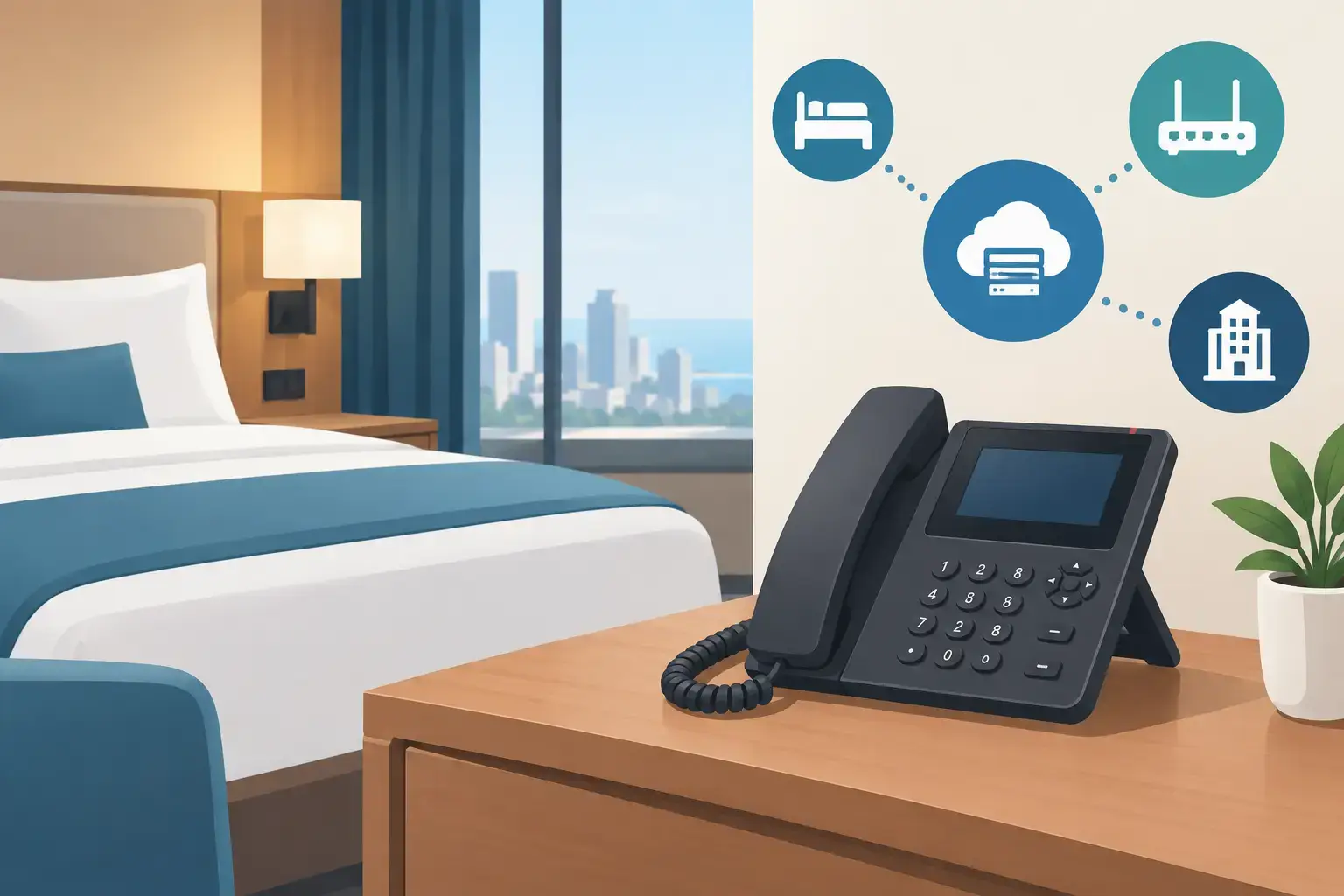
A guest may only use the bedside telephone once, perhaps to call reception after a delayed arrival or request an early breakfast. That brief interaction still says something about the hotel. Hotel SIP phones need to work immediately, feel appropriate to the room and give the operations team a dependable route to the guest. The right model is not simply a handset connected to a network. It is part of the guest experience, the room design and the property’s communications infrastructure.
For hotel owners, developers and project teams, the decision is best made early. A telephone chosen after the room scheme and network design are fixed can create unnecessary compromises. A well-specified SIP phone, by contrast, can support the hotel PBX, simplify deployment and look as though it was always intended to be there.
What hotel SIP phones need to do
SIP, or Session Initiation Protocol, is the standard commonly used to establish voice calls over an IP network. In practical hotel terms, SIP phones connect through the property’s data network rather than a traditional analogue telephone line. They can work with an on-premise IP-PBX or, where appropriate, a hosted telephony platform.
That brings useful operational benefits. Extensions can be programmed centrally, room calls can be routed to the correct department, and telephone settings can be managed without visiting every room. When a room changes status or a handset needs replacement, the technical team should not have to rebuild the whole configuration at the bedside.
Yet the technology is only one part of the specification. A hotel telephone should make the most common guest actions obvious. Reception, housekeeping, room service, concierge or emergency assistance may need dedicated keys, clear labels and the right numbering plan behind them. The exact requirements vary by property. A compact city hotel may prioritise a direct reception key and a discreet footprint; a resort may require more service keys and multilingual labelling.
Start with the PBX, not the handset
The first question is compatibility. Before selecting a style, establish which PBX or hosted platform the hotel uses, which SIP versions and codecs it supports, and how devices will be provisioned. This is a conversation for the hotel’s IT team, telecoms integrator and telephone supplier, not an assumption based on a product photograph.
Ask whether phones will receive their configuration through remote provisioning, whether the network uses separate voice VLANs, and whether power will be supplied by Power over Ethernet. PoE can make installation tidier because a single Ethernet cable carries both data and power. It can also reduce the number of mains adaptors in guest rooms. However, it relies on suitably specified network switches and sufficient power budget across the property.
Some projects need a secondary Ethernet port for a guest device, while others deliberately avoid pass-through connections to keep room networking simpler. Some operators require central directory access or call accounting integration. Others want a straightforward, locked-down room phone with a small number of service functions. There is no virtue in specifying features that the property will never use. There is real value in ensuring the functions it does need are reliable and easy to administer.
Emergency calling deserves particular attention. Local requirements, the hotel’s calling plan and the PBX configuration must work together so that emergency calls are routed correctly and, where required, provide accurate location information. This should be verified during commissioning rather than left as a line item on a specification sheet.
Specification checklist
| Item | Question to ask | Why it matters |
|---|---|---|
| Phone system | Which IP-PBX or hosted platform, and does it accept standard SIP endpoints? | Compatibility decides which handsets can be used at all |
| Provisioning | Will phones be auto-provisioned, and who owns the templates? | Fast installation and consistent settings in every room |
| Power | Is Power over Ethernet available, with enough switch power budget? | Avoids a mains adaptor at every bedside |
| Network | Is there a voice VLAN and quality-of-service on the switches? | Clear calls when the network is busy |
| Service keys | Which services get one-touch keys, and how are they labelled? | Guests reach the right team first time |
| Emergency routing | Where does the emergency key go, and can guests dial 999/112? | Safety, and the hotel’s duty of care |
| Spares | How many preconfigured spares, and where are they kept? | Rooms stay sellable when a phone fails |
| Finish and branding | Colour, logo and labels, and are spares from the same batch? | A consistent look across every room |
Provisioning and replacement planning
A well-run hotel expects rooms to remain available, even when equipment needs attention. Choose hotel SIP phones that can be configured consistently and replaced without a lengthy manual set-up. Keeping a small number of preconfigured spare units, with clear records of room profiles and firmware versions, is a sensible operational measure.
For larger roll-outs, agree the provisioning method before delivery. It affects how quickly devices can be installed, tested and handed over. It also helps avoid the familiar final-week pressure in which room numbers, button labels and network settings all change at once.
Design is a functional choice, not a finishing touch
Guest-room telephones are highly visible objects. In a carefully designed room, a generic black IP handset can look like an afterthought. In a heritage building, it may actively undermine the character that guests have paid to experience. That does not mean a hotel has to choose between period style and current communications.
A vintage-inspired form can sit comfortably within a modern SIP/IP deployment, bringing warmth and recognisable character to a room while meeting the practical demands of an IP network. The best choice depends on the interior concept, the available surface space and how the phone will be used.
A classic desk telephone can become part of a boutique hotel’s visual language, particularly where the room scheme includes traditional furniture, rich colour or British heritage references. A wall-mounted or compact unit may make better use of space in a guest room, corridor or service area. In every case, assess the handset’s weight and feel, the visibility of the keys, the quality of labelling and how easily the unit can be cleaned and maintained.
Colour also carries more weight in hospitality than it does in an office installation. A telephone can blend quietly into a restrained room palette or become a purposeful accent. Custom colours and logo branding allow hotel groups and independent properties to make the telephone part of a coherent identity rather than an off-the-shelf compromise. The key is restraint: branding should be durable, legible and consistent with the guest environment, not so prominent that it feels promotional.
Specify for the people who will use it
Procurement decisions often focus on the guest room, but several groups use and support the telephone throughout its life. Guests need intuitive calling. Housekeeping needs equipment that withstands routine cleaning. Reception needs calls to arrive with the right context. IT teams need devices that fit the network standard. Designers need a finish that remains true to the approved scheme. A suitable model respects all of these requirements.
Button layout is a good example. Too many keys can confuse a guest, particularly when labels are abbreviated. Too few can force them to remember an extension number at the moment they need help. The answer is usually a short set of clearly named, high-value services, supported by a sensible dial plan. If the hotel serves international guests, consider whether wording, symbols or multilingual inserts are needed.
Accessibility should be considered from the beginning too. High-contrast labelling, readable type and tactilely clear buttons can make the phone easier for many guests to use. Hearing compatibility requirements and local accessibility standards should be checked as part of the project brief, especially across multi-country portfolios.
A practical brief for hospitality projects
The strongest hotel telephone briefs are specific without becoming needlessly technical. They state the telephony platform, number of rooms and required extensions; identify where phones will be located; define key functions and labelling; and record finish, branding and installation constraints. They should also cover the less visible details, such as PoE availability, network port requirements, cable routes and the process for testing every room.
For refurbishment projects, survey the existing infrastructure before committing to SIP. Some hotels have legacy analogue cabling that remains suitable for analogue phones, while others are already equipped with structured cabling and IP switching. Moving to SIP may offer greater control and flexibility, but it can involve network upgrades, switch capacity and staff training. The right answer depends on the wider communications plan, not on fashion.
New-build projects offer more freedom, but they still benefit from early coordination. Interior designers can allow for the correct cable exit and furniture position. Telecoms specialists can confirm network coverage and power. The operator can agree the guest services that deserve one-touch access. Bringing those decisions together prevents an attractive room from being compromised by an awkward cable, inaccessible socket or unsuitable handset position.
A simple rollout sequence
- Survey: confirm the PBX, cabling, PoE and network ports for each phone position.
- Sample room: install one handset on the live system and test reception, service keys and emergency speed dials.
- Provision: build the templates for each room type and push them to every phone.
- Install and test: test every room, not a sample, and record the results.
- Hand over: give the hotel a register of handsets, key labels, destinations and spares.
GPO SIP hotel phones compared
Every model below is a classic GPO design built as a SIP phone. All GPO SIP phones support auto-provisioning and firmware upgrades over the web, and come with an RJ45 patch cable for installation.
| Model | Style | Size (W × D × H) and weight | Finishes |
|---|---|---|---|
| GPO 746 Push Button SIP | 1970s British desk phone, push-button | 21.5 × 16 × 14.5 cm, 0.9 kg | Black or red; other colours on request |
| GPO 200 Push Button SIP | Bakelite-inspired desk phone | 23 × 16.5 × 18.5 cm, 1.15 kg | Black |
| GPO Carrington SIP | Upright classic with a small footprint | 16 × 16.5 × 22.5 cm, 0.85 kg | Black; other colours on request |
| GPO Duke SIP | Traditional desk phone | 23 × 16.5 × 18.5 cm, 1.15 kg | Black |
| GPO 746 Wallphone SIP | Wall-mounted 746 | 14.5 × 8.5 × 24 cm, 0.75 kg | Black or red; other colours on request |
Choosing a supplier for long-term deployment
A hospitality telephone is rarely a one-off purchase. Hotels need continuity when they add rooms, replace damaged units, refresh a floor or open another property. Look for a supplier that understands both product presentation and deployment detail, and that can support consistent finishes, labels and configurations over time.
For international projects, trade partners and local integrators also matter. They can support installation, PBX coordination and practical aftercare in the market where the hotel operates. GPO Retro supplies design-led analogue and SIP/IP hotel telephones for projects that need this balance of distinctive appearance, practical compatibility and bespoke options.
The most effective hotel SIP phone is one guests can use without thinking, staff can support without frustration and designers are pleased to leave in view. Specify it as part of the room and the network from the outset, and it will earn its place long after the opening photographs have been taken.
Frequently asked questions
What is a hotel SIP phone?
A telephone that makes calls over the hotel’s IP network using the SIP standard, registering with an IP-PBX or hosted phone platform instead of an analogue line.
Do hotel SIP phones need Power over Ethernet?
Not necessarily. PoE lets one network cable carry data and power, which keeps bedsides tidy; without it, each phone needs a local power adaptor.
Can SIP phones be set up centrally?
Yes. GPO SIP phones support auto-provisioning and web firmware upgrades, so settings and service keys can be managed for every room from one place.
Planning a hotel phone project?
Browse our SIP/IP hotel phones and analogue hotel phones, see hotels using GPO phones, or request a quote for your property.